Behind the scenes
Spoilers past this point
This is the workshop. It's where I keep the secrets the wiki doesn't tell, the real places and stories I built Nuitai from, the ideas that aren't canon yet and the questions I haven't answered. If you'd rather meet the world the way a player will, go back to the wiki.
Why Nuitai exists
A vast, bright, colorful water world of scattered islands with colossal wonders on the horizon, inspired by the nature, cultures and mythology of the Pacific.
That's how I describe it. I'm building it for a turn-based RPG, and everything on this site is a step toward that game. It's all a work in progress.
It started with Final Fantasy X, about twenty years ago, and with being tired of fantasy that's always dark, cold and medieval European. I made Nuitai the opposite on purpose: bright water, warm islands, and cultures fantasy rarely visits, Polynesia and maritime Southeast Asia above all.
I got the idea from One Piece that every island should have its own premise, so sailing to a new one feels like opening a new book. And a small country like Kiribati, a few hundred square miles of land scattered over a huge sea, is how I want the map to feel: a little land in a lot of ocean.
The circle
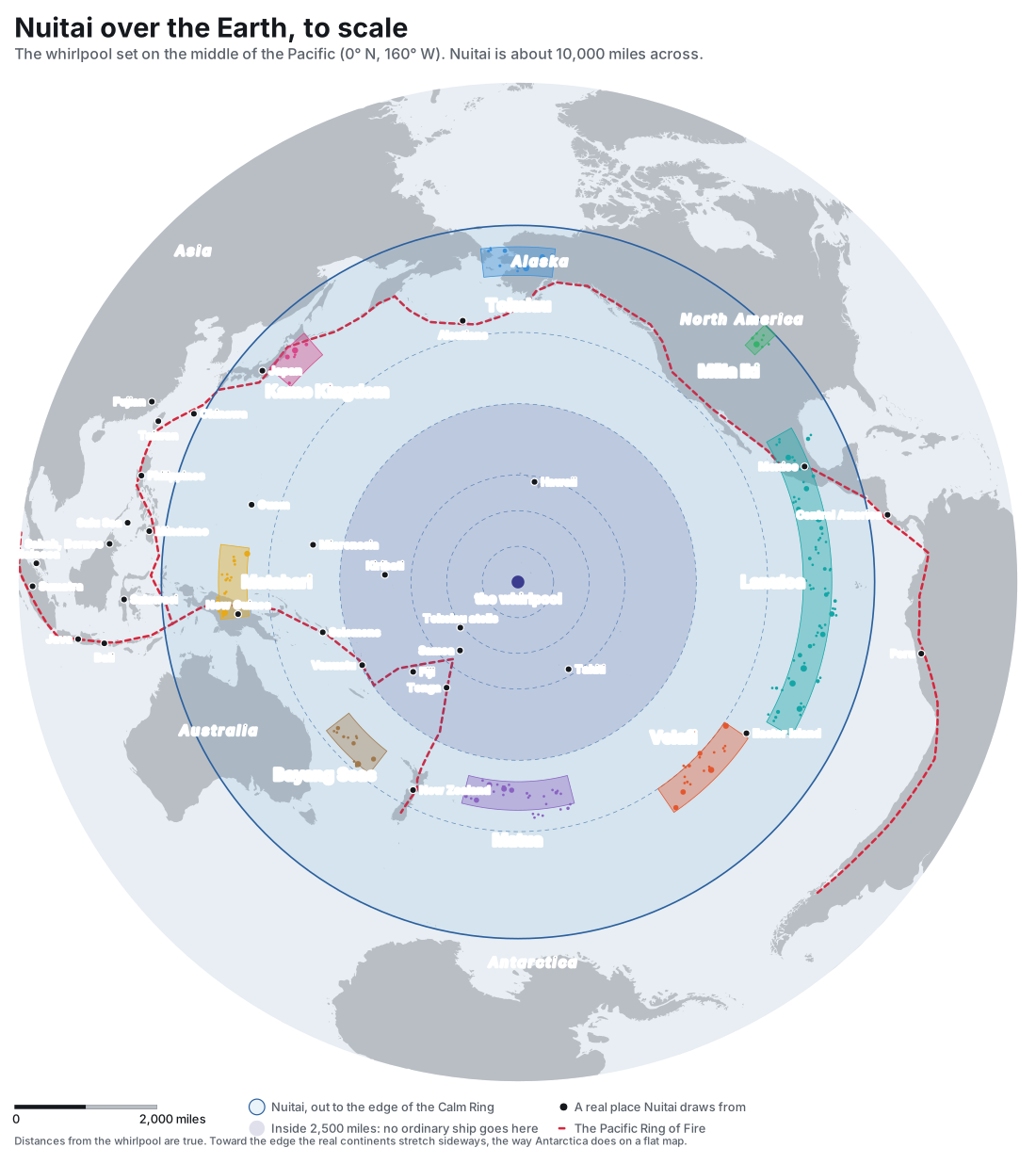
Before I knew it had a name, I drew a circle on a map of the real world: Hawaii, down to New Zealand, across to maritime Southeast Asia and up to Japan. That circle turned out to be almost exactly the Pacific Ring of Fire, the ring of volcanoes around the ocean. That's my circle!
So the ring became my rule. Every inspiration comes from inside it, the ring and everything it encloses. Anything from outside has to arrive by sea through a place on the ring, the way India's faiths reached Bali. That's how the Bandari bring a Hindu and Buddhist inheritance into the islands.
The rule cuts things too. Haitian Vodou was part of the dark Matua look for a long time, and I took it out because Haiti is outside the ring. I only ever wanted the look, and the ring has its own macabre ancestor traditions I can draw on instead: the Toraja of Sulawesi and the carvers of the Sepik.
Laid out as a ring around a whirlpool, Nuitai is about the size of the whole Pacific. The directions mostly match the real ocean, but I stretched the distances to the west and south to close the ring.
Small choices with a story
- Light is La, not Ra
- The Māori word for the sun is rā. Written Ra, it read too much like the Egyptian sun god, so the element is La, and Ra is only how the people of Matua say it.
- Ata used to be Aku
- The god of darkness and fear was renamed partly to get away from Aku, the villain of Samurai Jack. Ata means shadow in Samoan and Māori.
- Kulāiwi, the starting island
- Hawaiian for homeland. Taken apart, the word means something like "plain of bones," and I chose it for the whole word, not its pieces.
- Magic is kinesthetic
- Every spell needs a motion or a breath. A tied-up mage can't cast. I picked the word even though it sounds like a school learning style, because it says exactly what I mean.
- No drawn map is canon
- The real map is a table: every region's direction, distance in miles and width. A program draws the pictures from that table, so a picture can never disagree with the world. The island shapes on the maps are invented.
- "Fluxx rules"
- After the card game: the stronger a move, the more of a wildcard it should be. Paku's Tidal Wave hits every enemy, then washes his own party around, Paku included.
- No MP
- I was never a fan of MP. Moves have waits and cooldowns instead of a magic bar.
- People are not Pokémon
- Monsters have elemental weaknesses. People do not.
- Paku is not Maui
- Paku's look comes from Garp in One Piece first, then Whitebeard, Might Guy and All Might. Disney's Maui is the look I stay away from.
- Eight hundred years
- The Bandari arrived eight centuries ago, around the time the real Polynesian long voyages between Hawaii and Tahiti were about to end for good. Far enough back that nobody alive can settle an argument about the homeland they came from.
- Shaka's face is never shown
- Art shows his symbols, the sun and his sword in the sand, or his back. It borrows from early Buddhist art, which showed the Buddha only through symbols. And Shaka died choking on breadfruit, a plain death at the end of a sage's life, the way the Buddha died after a meal of spoiled food.
The secrets the wiki keeps
The Luminary of Kota Emas. The old Luminary is dead, and the temple is hiding it. The new Luminary, Tahji, is a child of about eight and a gaja, one of the elephant people, chosen by a test the way a reincarnation is found. The priest who repeats his words is the one really ruling. The curtain and the story of an illness go further than the tradition of the veiled face: they hide how young he is.
The model is the Fifth Dalai Lama, whose death in 1682 his regent hid for about fifteen years.
Still not settled: what it costs when the secret comes out, and whether the old Luminary was a gaja too.
Where it comes from
The real places, words, myths and games behind each part of Nuitai, the ones I've confirmed. Open a group to read it.
Places7
- Māla Iki Islands
- Hawaii, "but all things idyllic"
- Lanuloa Archipelago
- Shaped like the Philippines: a long north-to-south chain. Its people wear the pre-colonial Philippine wardrobe and its monsters are Philippine
- Fire Islands
- The Solomon Islands and Vanuatu
- Matua Archipelago
- New Guinea area (Papua New Guinea)
- Matahari Archipelago
- Indonesia and the other Southeast Asian islands
- Kame Kingdom
- Southern Japanese islands, like the Ryukyu Islands
- Tokelau (North Sea)
- The Bering Sea and the Aleutian Islands. Its otter people draw on the Aleut (Unangan)
History and dates5
- Shaka's illumination
- The Buddha. The date was set for the story's arithmetic, not to match his.
- The Bandari arrive
- Around 1200 CE: Polynesians settling New Zealand, and the long voyages between Hawaii and Tahiti about to end for good.
- Kota Emas founded by survivors
- Malacca, a golden trade city founded about 1400 by Parameswara, a prince fleeing the fall of Singapura.
- The Bandari's lost first settlement, a century before Kota Emas
- Singapura, founded about 1299 by Sang Nila Utama, half legend in the Malay Annals; about a century later his descendant Parameswara lost it and founded Malacca.
- The Luminary's death kept secret
- The Fifth Dalai Lama, whose death in 1682 his regent hid for about 15 years. The Luminary found by a test as a reincarnation is how a Dalai Lama is found.
The world as a whole12
- Why Nuitai exists
- Final Fantasy X, twenty years ago, and being tired of dark western medieval fantasy
- The cultures
- Under-represented in fantasy: maritime Southeast Asia and Polynesia
- Nuitai's circle, the frame
- The Pacific Ring of Fire, the ring and everything it encloses. Every inspiration comes from inside it; anything from outside arrives by sea through a place on the ring, the way Hinduism reached Bali. I drew the circle, Hawaii to New Zealand to maritime Southeast Asia to Japan, before he knew the ring existed: "that is my circle!"
- The spirituality
- Buddhism, Taoism, Shinto and other animist and nature religions, and indigenous polytheism
- The map region
- Oceania and Polynesia, plus Okinawa and the Ryukyus
- A map of waters, a little land in a huge sea
- Kiribati, about 310 square miles of land
- Islands each with their own premise
- One Piece
- Lanuloa, the Grand Line of this world
- One Piece's Grand Line
- Lanuloa as a region of archipelagos
- The Malay Archipelago
- Lanuloa as the melting pot
- Hawaii, the Philippines, and South America through the Lanigata; the pineapple is the first South American plant in it
- Fire Islands, real model
- Several South Pacific islands, never one: Samoa (the accent, the fire dancing, the sister covenant), Vanuatu (the volcanoes), the Solomon Islands (the shell money, the map), with Tonga (the fahu) and Fiji (the Beqa firewalkers) to draw on
- Sky people ruins
- Maya, Aztec and Inca temples, and Easter Island's megaliths
Words and names54
- Nuitai
- Polynesian nui (great) + tai (sea)
- Nuitai'lo
- Nuitai + Hawaiian ʻōlelo, speech
- Nuitagata
- nui + tai + gata, from tangata / kanaka / taʻata (person) and Japanese kata
- Laniakea, the cosmos
- The Laniakea Supercluster, Hawaiian "immense heaven"
- Kulāiwi
- Hawaiian, homeland. Chosen for "homeland," not its parts, "plain of bones"
- Ikagata, "the fish people"
- Māori and Tongan ika, Hawaiian and Samoan iʻa (fish), which is also Japanese ika (squid), + -gata. A joke on purpose: fish to the islands, squid to the Kame
- Ika no Toshi
- Japanese イカの都市, city of the squid
- Māla Iki
- Hawaiian māla (garden) + iki (small); was Māori Māra Iti
- Matua
- Polynesian parent; was Hawaiian mākua
- Velafi
- Samoan vela (hot) + afi (fire)
- Bayang Seas
- Indonesian bayang, shadow
- Bandar
- Renamed for sound from Benar, Malay "true"
- Halabena
- Malay, "the way of truth"
- Ajaran Shaka
- Malay ajaran, teaching
- Jalan Suria
- Malay jalan (way) + suria (sun), from Sanskrit surya
- Jalan Cermin
- Malay jalan (way) + cermin (mirror)
- Hulia, Kelemini
- Malay suria and cermin as Hawaiian ears would bend them
- Kame
- Japanese, turtle
- Tokelau and its other forms
- Māori tokerau (north wind), Samoan toʻelau (trade wind), Hawaiian Koʻolau
- Mauga
- Samoan, mountain
- Akua, Akua Nui, Akua Iki
- Hawaiian god, great, small
- Ngaro
- Hawaiian nalo, Samoan galo, Māori ngaro: hidden, lost
- Marama
- Māori moon and light, Hawaiian malama
- Pōhaku
- Hawaiian, stone or rock, which I read as pō + haku, golem
- Pōlelo, stone speech
- Hawaiian pōhaku + ʻōlelo
- Pua'a
- Hawaiian, pig
- Lelua
- Hawaiian lele (fly) + lua (the Hawaiian martial art)
- Mā, the magic root
- Japanese ma, as in mahō, magic
- La'gata, Shaka's title
- The Buddha's title, Tathāgata
- Sarpic and Deva names
- Sanskrit kept whole, the way Bali and Indonesia keep it
- Bandari personal names
- Everyday Malay and Indonesian words
- Damar Jago
- Malay damar (resin torch), jago (champion, fighting rooster)
- Asap Setia
- Malay asap (smoke), setia (loyal)
- Sarjana
- Indonesian, scholar
- Penyamun
- Malay, robber
- Lanun, pirates
- Malay, pirate
- Olola
- Aurora, bent to Orora, then Olola
- Tawiri
- Māori Tāwhiri, as in Tāwhirimātea, god of weather
- Ikagata
- Japanese ika, squid
- Ata (was Aku)
- Samoan and Māori ata, shadow. Renamed partly to get away from Aku, the Samurai Jack villain
- The elements
- Ahi, fire (Hawaiian, Māori; Samoan afi); Wai, water; Lau, leaf; La, sun (Māori rā, written La partly because Ra is the Egyptian sun god)
- Blue Ring
- The blue-ringed octopus
- King Kamehameha
- The Hawaiian king, and the Dragon Ball move
- Wiliwai, the Great Whirlpool's everyday name
- Hawaiian wiliwai, whirlpool, one word. Built from wili + wai and landed on the real word
- Lanu
- The word for colour, Samoan lanu
- Atoma
- A play on "atom" and "atomic" and the Hindu ātman, the soul
- Kolindala
- Sanskrit kuṇḍalinī, coiled energy
- Jangaya
- Jang, war
- Charu
- Chaturanga, the Indian ancestor of chess. I does not remember choosing it, but it cannot be a coincidence
- Keo
- A list of Hawaiian baby names
- Kiki, Maika
- Chosen for the sound alone; the real Hawaiian words are chance
- Tamba Uli
- Generated at random by ChatGPT
- Tandayag na Opon
- Came with the free Philippine monster pack, not from I
- Hauhake, Mohala, the season names
- Not real season names, on purpose: hauhake is Māori for harvesting root crops, mohala Hawaiian for blossoming, and the mismatch is intended. Kau and hoʻoilo are the real Hawaiian summer and winter
Gods and faith22
- Shaka
- The Buddha, with some of the Monkey King
- Pua'a's meat, eaten to honor him
- Hawaiian pigs offered to the gods and then eaten; Kamapua'a, the pig god. my own picture is Christian communion, "eat of my body"
- What the faiths eat
- Golden Sun's no pork: Islam beside Buddhism in Indonesia and Malaysia; Māla's vegetarianism: Buddhist vegetarianism
- Shaka's face never shown
- A mix of the custom of never showing Muhammad and early Buddhist art that showed the Buddha only through symbols
- Shakans shun idolatry; Shaka shown veiled in the past, taboo now
- Islam's avoidance of pictures of Muhammad: to keep love for a man from becoming worship, from later tradition rather than the Quran, with older Persian and Ottoman art showing him veiled in white or in a flame halo; and the aniconic phase of early Buddhist art, roughly the first four centuries after the Buddha, when he was shown only by symbols: an empty throne, his footprints, the Bodhi tree, a wheel, a parasol
- The Teachings of Shaka, the Spiral
- Buddhism: karma, attachment, death and rebirth
- Sarpa, and Shaka growing out of it
- Hinduism, the way Buddhism grew out of it. Bali is the model for a place that kept both. "Indian, South Asian, Balinese, Vedic". Balinese Hinduism as it looks, split gates, palm-leaf offerings, masked dance, the day of silence, arrived by sea with the Bandari
- Jangya
- Hindu imagery, but he must not look like Ganesha
- Lanu
- The Hawaiian god Kāne, made female, and Te Fiti from Moana
- Moanatu
- Kanaloa, more than Poseidon
- Mauga
- Pele, the Hawaiian volcano goddess. The name is Samoan for mountain
- Anúa
- Animism, like Shinto
- The old gods of the sky people
- Polynesian gods, plus native Central and South American gods
- The Māra name clash
- Māra, the demon who tempts the Buddha, and the Elder Scrolls goddess. I found it interesting, not a problem
- Mana
- The real Oceanic idea, including mana pooling in people and things
- Magic's written limits
- Sanderson's laws of magic
- How magic looks
- Between Avatar and Demon Slayer
- Channeling through breath
- Taoism, tai chi, Demon Slayer's breathing styles
- Every faith is right
- The Elder Scrolls
- Nagas
- The many-armed nagas of Southeast Asian art
- Sarimanoks, Lanuloa's giant riding birds
- The Sarimanok, the legendary rooster of the Maranao of Mindanao, with a rainbow tail; the giant bird in the Gubat Banwa picture; the chocobo
- Sarimanoks native to Matahari, carried east by the Bandari
- The chicken, domesticated from the red junglefowl of Southeast Asia and carried across the Pacific by Austronesian voyagers
Peoples and characters65
- Maika
- Hawaiian lomilomi, healing massage, as something he practices (not a stance); Hawaiian lua, the old fighting art, a candidate for his Mana stance
- Mako
- Filipino Kali (Eskrima), "defanging the snake": striking the attacking arm instead of blocking, which also suits Ren; kung fu animal styles like crane style; the name is the Māori word for shark, which gave English the mako shark; the east's Manoniho is mano, shark, and niho, tooth
- Kage Odori
- Butoh, Japanese, begun in the 1950s as Ankoku Butoh, "the dance of utter darkness"
- Tari Bayang
- Wayang, the Javanese and Balinese shadow puppet theater, and wayang wong, the dance drama where people move like the puppets
- Sukunakame
- Sukunabikona, the Japanese kami of medicine, hot springs and sake, with kame in place of bikona
- Sukuna Suiken
- Drunken boxing, Chinese zui quan, suiken in Japanese (酔拳); it reaches the Kame by sea, the way Okinawan karate came from Fujian
- Rongoā, Mākutu
- Māori rongoā, traditional plant medicine, still practiced; Māori mākutu, sorcery or a curse
- Kilomi
- Hawaiian lua (Kapu Kuʻialua) merged with Neji's Gentle Fist in Naruto, itself after the Chinese Baguazhang; the medical ninjas, tai chi and pressure points; the name from Hawaiian kī (ti plant) and lomi (to press)
- Cermin Air
- Chen style tai chi, the way Leifang fights in Dead or Alive: arms that keep circling slowly even at rest. Tai chi is Chinese, outside the ring, so it arrives by sea, the way Okinawan karate came from Fujian and Chen style reached Taiwan; Wai'Kenpō, which Cermin Air reworks, is Okinawan karate
- Hina's stances
- The Māla priests' dance, after a sun salutation and old temple hula (hula kahiko); Shakan Mudras after Buddhist mudras and the kuji-in chain behind Naruto's hand signs
- Damar's hidden Sarpic martial art (spoiler)
- Kerala and its martial art, Kalaripayattu. Kerala is outside the ring, so it arrives by sea with Sarpa. Not ruled
- Pua'gata
- The Vanara, the eastern counterpart: a sister people born rarely among the Nuitagata, as the Vanara among the Bandari
- Leilagi running on all fours
- Ayla in Chrono Trigger
- The six sacred beasts
- Kaiju, the Japanese giant monster films (Godzilla, Mothra): "the sacred beasts are kaiju essentially"
- Pua'Lele's look
- Mothra is the inspiration, not to be copied wholesale; the body is a real silk moth, the Japanese moon moth (Actias artemis), in place of the Atlas moth
- Nuitagata
- Oceania and Polynesia, with Okinawa, plus Southeast Asian clothing. The Southeast Asian side comes from the Bandari, and the Gubat Banwa art, a Filipino tabletop game, is the clothing reference. The Philippine side lives in Lanuloa, the Sulu side in the Bayang
- The three accents
- East is Hawaiian, Velafi is Samoan, Matua is Māori
- Velafi fire dancing
- Samoa
- Velafi matriarchy
- The Samoan feagaiga, the sister-brother covenant
- Matua and the Callers
- Māori, plus the macabre ancestor traditions inside the ring: the Toraja of Sulawesi first, then the Sepik and malagan traditions of New Guinea. "Polynesia goes goth." Haitian Vodou is out: Haiti lies outside the ring. It was always the look, not the religion
- Bandari
- Southeast Asia: the foreign missionary culture with a Buddhist-like faith. Maritime Southeast Asia, Indonesian and Malaysian
- Bandari going by the family name
- Japanese custom
- Kame people
- Ryukyu and Okinawa. East Asian, Chinese and Japanese, above all the Ryukyus and Okinawa: the Zen and Taoist part of the world, where Nuitai's karate comes from, and they meditate
- The Kame's bodies
- The Ryukyu black-breasted leaf turtle, found only on Okinawa and two neighboring islands
- The Chelonians' bodies
- The sea turtles of the Okinawan seas: green, loggerhead and hawksbill
- The Kaerujin's bodies
- The Japanese common toad
- The Ranagata's bodies
- The red-eyed tree frog of Central America's Pacific side, by way of Lanuloa's South American thread, or a poison dart frog of the same coast
- The Ranagata's dress
- Lanuloa's pre-colonial Philippine look, with the Emberá of the Chocó rainforest on the Pacific coast of Colombia and Panama: beaded collars, bright striped wrapped skirts, black patterns painted on the skin. The Emberá also tip their blowgun darts with the poison of the golden poison frog, which is how poison dart frogs got their name
- Asap's body
- The granular poison frog of Costa Rica's Pacific side, red-orange with dark legs: a poisonous frog for a saboteur. I first pictured him orange or red
- The gajas' bodies
- The Asian elephant, which lives on the ring in Borneo and Sumatra, not the African
- The Umigame's name
- Japanese umigame, sea turtle
- The Mokomoko's bodies
- The frilled-neck lizard of Australia and New Guinea
- The Mokomoko's silent language
- The frilled-neck lizard's displays: the flared frill, the gape, the head bob
- The Pekapeka's bodies
- The New Zealand short-tailed bat; pekapeka is Māori for bat
- The Pekapeka's sung language
- The short-tailed bat's echolocation, above human hearing, and the males' songs from their perches in the breeding season
- The Nagas' bodies
- The king cobra, as in the real naga myths
- The Nagas' growled language, heard through stone
- The king cobra's growl, the only snake's, and snakes feeling sound through the ground
- The Manogata's bodies, and Ren's shark side
- The tiger shark; manō is Hawaiian for shark
- The Manogata's language
- Japanese, distorted, as a harsh cousin of Malalo
- The boar line
- The Polynesian pig, carried across the Pacific by canoe
- The Vanara's bodies, and their place in the temples
- The long-tailed macaque, the temple monkey of Bali (Ubud, Uluwatu); the name from the Ramayana as Bali tells it
- Kame and Bandari speech
- Kame are Japanese; Bandari are Malay and Indonesian, with Sanskrit for sacred things
- Lanigata, feathered serpents
- Native South American art (the stone speech look). Easter Island plus Aztec and Inca, for the Lanigata and the old Lanuloa structures
- The Ikagata's two halves
- South America from the drowned Lanigata ruins they keep (the Moche, Chan Chan and the Inca quipu as models), East Asia from the Kame they trade with (the Ryukyus, Ryūgū-jō, Nirai Kanai). Their road under Tokelau is the Aleutians, where the ring's two halves meet
- The otter people of Tokelau
- The Aleut (Unangan) of the Aleutian Islands, and the sea otter.
- Pōhaku golems
- The Legend of Zelda, Shadow of the Colossus
- Vanara
- A film Monkey King, for the face
- Hina and the Māla priests
- Yuna from Final Fantasy X, and Shinto priestesses
- Hina's name
- Hina, the Polynesian goddess, often tied to the moon
- The Callers' death magic
- Lulu from Final Fantasy X
- Kailo's martial magic
- The benders of Avatar; tai chi, wuxia, karate. Its first name was Wu Wei
- Olola
- Ty Lee from Avatar, for the fighting
- Genemon
- Jinbei from One Piece ("Jinbei vibes"); Roshi and Miyagi were considered
- Genemon and Olola in battle
- The Final Fantasy Monk
- Kiki
- Yuffie or Rikku
- Tawiri
- The old Matua witch idea, "voiced by Kate Mulgrew" as a joke
- Paku's look
- Garp above all, then Whitebeard, Might Guy, an older Kamina, All Might, Armstrong. Disney's Maui is the look to avoid
- Asap's personality
- Amos Burton from The Expanse
- Asap's look and kit
- A ninja dressed as a Betawi silat fighter, the jawara, so he reads as a ninja without the Japanese pieces: the black pangsi, the batik iket wrapped close over the head with one point up, a matching batik sash; his weapons are the Minangkabau kerambit and the blowgun of Borneo, its darts tipped with his own poison. A first try mixed pieces from five places and looked mismatched, so the clothes now come from one outfit
- Tahji's personality
- Pure Aang, or cowardly Gohan (a question in the notes)
- Pua'a's personality
- Monkey D. Luffy
- Zealots and Wai'Ki Wardens
- The D&D Paladin
- Wai'Kenpō
- Karate, "water style karate"
- Lelua
- The Samoan fire knife dance (siva afi) and Capoeira (Brazilian, outside the ring, so only the look)
- Bayang pirates, Ren
- One Piece and the Golden Age of Piracy
Culture and things17
- Clothing
- Polynesian and Southeast Asian, in the spirit of Chrono Cross and Final Fantasy X
- Bandari buildings
- Indonesian and Malay vernacular houses: the rumah adat and Malay stilt houses with tiered or horned roofs; old Malacca's mosques have three-tiered pyramid roofs and pagoda minarets. Not Thai temples. Kota Emas is a melting pot like Malacca, so it shows variety
- Ships
- Junks with slanted sails, or island canoes, never galleons
- Milk: Bandari buffalo curd, Nuitagata coconut milk
- Dadiah, water buffalo milk fermented in bamboo in West Sumatra, and carabao milk in the Philippines; most East Asian and Pacific Islander adults cannot digest milk well, and Polynesia had no dairy animals
- Gajas eat no meat
- Elephants are plant eaters and love sugarcane
- Weapons and tech level
- The Golden Age of Piracy at the most
- Shell-string money
- The Solomon Islands
- Barter plus coin in the east
- Morrowind
- Māla Iki dyed cloth
- Besaid in Final Fantasy X
- Kava
- The real Pacific drink
- Kaigara and Charu
- Go and chess, as placeholders
- Script ciphers
- Aurebesh from Star Wars and Al Bhed from Final Fantasy X
- Bandhasa script look
- Thai, Tibetan, Devanagari, Hiragana
- Stone Speech script
- South American stone carving, Final Fantasy X glyphs, Rongorongo
- God temples
- Zelda dungeons
- Nuitai's baseline fashion, first drawn for Lanuloa
- The Gubat Banwa picture: the head cloths, the hand wraps, the action poses, the parasol with streamers, the patterned cloth, the squarish swords, the jewelry and tattoos, the animal people. Brighter than the picture, less brown, no guns
- The head cloth, the putong
- Pre-colonial Philippine men's head cloth; to me it recalls Jecht and Wakka in Final Fantasy X
The game30
- Influences overall
- Final Fantasy X first; then Moana, Chrono Cross, One Piece, Avatar, Raya, Ghibli, Zelda, Shadow of the Colossus, Star Wars, Sanderson
- A cast of fifteen
- Final Fantasy VI and Chrono Cross
- The finished game
- A Super Nintendo JRPG in the line of Chrono Trigger, Final Fantasy VI and Dragon Quest
- Default rules
- Classic Final Fantasy
- CTB turns, swapping, the command menu
- Final Fantasy X
- Every enemy has an answer; bosses have a hook
- Final Fantasy X: Wakka for fliers, Auron for armor; Yunalesca
- Combos
- Chrono Trigger double techs, including both characters being ready
- Party picker
- Chrono Trigger
- Shared bag plus pockets
- Dragon Quest
- Battle text, monsters alone on screen
- Dragon Quest
- Picture map
- A Dragon Quest overworld; Final Fantasy VI and Chrono Trigger world maps
- Fluxx rules
- The card game Fluxx
- No Fire, Fira, Firaga
- Rejecting Final Fantasy's tiers
- No MP
- "I was never a fan of MP"
- The six elements
- The six sages and medallions of Ocarina of Time
- The six roles
- Final Fantasy XIII's paradigm roles
- Weakness triangles
- Pokémon, but people have no weaknesses ("People are not Pokemon")
- Effectiveness messages
- Pokémon, as a placeholder
- Burn
- Pokémon
- Zombie
- Final Fantasy
- Ten stats
- Final Fantasy X
- Growth by use, no levels
- Final Fantasy II and The Elder Scrolls; one check a battle like Call of Cthulhu
- Defend
- Final Fantasy IV to VII
- A character's pair is their job
- Kimahri as a blue mage in Final Fantasy X
- Move names (Cure, Esuna, Haste, Flare, Regen, Protect, Shell, Berserk, Throw, Kill, Mug)
- Final Fantasy, as placeholders on purpose
- Armor Break, Mental Break
- Final Fantasy X
- Pōhuehue (it was Vine Whip, from Pokémon)
- The beach morning glory; Hawaiian surfers lashed the water with its vines to call up waves
- Tinju Surya (it was Solar Fist)
- Indonesian for "fist of the sun"; surya is the formal Sanskrit-rooted word for the sun
- Gohei, Hina's and Tahji's wand
- The Shinto paper wand
- Monsters in the pygame game
- Philippine folklore, from a free sprite pack
Story and writing5
- A small plot that grows into a large one
- Chrono Trigger, from a missing girl to Lavos
- No chosen ones
- The tropes-to-avoid list
- The codex voice
- Mass Effect's codex
- In-world books
- The Elder Scrolls
- Bandar as a mystery
- Akavir in The Elder Scrolls
Found afterward: real echoes discovered later1
- Pua'a
- Kamapua'a, the Hawaiian pig demigod: a shapeshifting trickster and famous lover. In the best-known story he courts Pele, and their fight shapes the land. Pele is Mauga's source.
The languages12
- Nuitai'lo
Hawaiian, Samoan, Māori. Nuitai'lo's roots are Polynesian, and each accent is modeled on one real language: Hawaiian in the east, Samoan in Velafi, Māori in Matua. Real cognates are the test of a word's history.
Why this way round: Māla Iki is the Hawaii of this world, and I find the l softer and gentler. The south keeping the old sounds matches the Callers keeping the oldest form of the faith. This replaced an earlier rule (east Māori, south Hawaiian), which had grown out of two place names: Māra is Māori for garden and Mākua is Hawaiian for parent.
-gata comes from tangata, a person; the real Hawaiian word is kanaka, which is why the east says -naka. Maita holds up because Hawaiian maika'i is Tahitian maita'i. In Matua, the real Māori forms of ahi and pōhatu use h, so those keep it. Māla Iki is Hawaiian: māla, garden, and iki, small. Māla is also Māori māra. Laniakea, the cosmos, is named for the Laniakea Supercluster, Hawaiian for "open skies". Lá'gata, Shaka's title, is after the Buddha's, Tathāgata.
Several names are real words in all three accents. N'garo: Hawaiian nalo is hidden or vanished, Samoan galo is forgotten, Māori ngaro is hidden or lost. Malama is Hawaiian for the lunar month and for light. Tokerau is tied to the north and the north wind in Māori, Samoan to'elau is the trade wind, and Ko'olau is the Hawaiian windward side. Vela, wela and wera are the Samoan, Hawaiian and Māori words for hot. Ata is Hawaiian aka, Samoan and Māori ata, shadow.
The light element was once labeled Ra; Ra was too close to the Egyptian sun god.
Names kept away from: Moana means ocean and the Disney film took it; Moanatu and Moanaroa are near enough to be deliberate and far enough to be safe. Moananuiākea is the real Hawaiian name for the Pacific, so it is not used. Māra, the Matua form of Māla, collides with the demon who tempts the Buddha and with the Elder Scrolls goddess of love; I find that interesting rather than a problem.
Of the unassigned roots, lā'au and lapa'au together make lā'au lapa'au, the real Hawaiian term for herbal medicine.
- Bandhasa
Malay and Indonesian, with Sanskrit. Bandhasa's words are Malay and Indonesian, with Sanskrit for old and sacred things. Each dialect has a real model: North Matahari is Javanese, Kota Emas is Malacca Malay, South Matahari is Ambonese and Papuan Malay, and the Bayang Seas are Tausug and Sama-Bajau. A dialect changes only how a word is said, never how it is spelled, the way Javanese writes Surabaya and says Suroboyo.
- The Bandhasa script
It is to look Southeast Asian. Real scripts to look at: Javanese, Balinese, Baybayin and the old Kawi script. As a cipher it works the way Aurebesh in Star Wars and Al Bhed in Final Fantasy X do.
- Malalo
Japanese. Malalo has the sounds of Japanese.
- Kamego
Okinawan. Kamego's real model is Okinawan, as Malalo's is Japanese. The Kame say Japanese-shaped words with Okinawan's three short vowels.
- The Umigame language
The sounds real turtles make. Turtles were long thought nearly silent. Recordings of dozens of species in 2022 found all of them making sounds: hatchlings click and chirp inside the egg so the nest hatches together, Amazon river turtle mothers answer them with low calls, giant tortoises groan and bellow when courting, red-footed tortoises cluck like chickens, and any turtle hisses as it pulls into its shell.
- Pekapeka'ro
The New Zealand short-tailed bat's songs. The New Zealand short-tailed bat. It finds its way by echolocation, calls pitched above human hearing. In the breeding season the males sing from a chosen perch in the roost tree to call the females, and the females come to the best singers.
- Mokomoko'lo
The frilled-neck lizard's frill and head bobs. The frilled-neck lizard of Australia and New Guinea. It is nearly silent apart from a hiss and talks with its body: when threatened it flares the frill, gapes its mouth and stands tall, and it bobs its head at rivals.
- Geram
The king cobra's growl, and snakes hearing through the ground. The king cobra, the one snake that growls: its hiss is pitched low, close to a dog's. Like every snake it is nearly deaf to sound in the air and feels vibrations through the ground with its jaw and body.
- Samego
Japanese, distorted: a harsh cousin of Malalo. Malalo is modeled on Japanese, so this is Japanese bent out of shape: a monster speaking distorted Japanese. Same is Japanese for shark.
- The otter people's speech
The otter people's language is drawn on Unangam Tunuu, the Aleut language, and the Ikagata say its words by Japanese sound rules.
- Stone Speech
Native South American, for the look. Stone Speech is to look native South American. As a cipher it works the way Aurebesh in Star Wars and Al Bhed in Final Fantasy X do.
Words in the Lexicon85
- aupuni / malo / rangatiratanga
- Hawaiian aupuni, Samoan mālō, Māori rangatiratanga, each the word for kingdom in its own Lord's Prayer
- ahi
- Fire in Hawaiian, Tahitian and Māori
- ata
- Shadow in Samoan and Māori; aka in Hawaiian.
- ka'e
- Hawaiian kaʻe
- gáta
- Compressed from tagata / kanaka / tangata / ta'ata; also kata, a polite Japanese "person," becoming -gata as a suffix. Races and species only, never a culture
- háku
- From pōhaku (stone), which I read as pō + haku, golem; haku in Hawaiian also means to braid or plait, and to compose poetry or song
- kúa
- Kua in Hawaiian is "back" or "behind"
- láni
- Lani in Hawaiian (lagi, langi, ragi elsewhere). Chosen for sound; lan is also blue in Chinese
- lau
- "Leaf" in Hawaiian
- lélo, -'lo
- From ōlelo
- mā
- Ma 魔, as in mahō 魔法
- hauháke
- Māori hauhake, to dig up and harvest crops.
- ho'oílo
- Hawaiian hoʻoilo, the rainy season, from ilo, to sprout
- kau
- Hawaiian kau, the warm dry season; also any season or stretch of time
- mana
- Mana, Oceanic cultures
- mohála
- Hawaiian mohala, unfolded, of flower petals. Not a real season name, on purpose, like hauháke
- nui
- Polynesian
- pito
- Pito in Māori, Tahitian and Rapa Nui, piko in Hawaiian. Easter Island is Te Pito o te Henua, the navel of the land. The whirlpool is Te Pito o Nuitai
- pule
- The cowrie in Samoan, the Fire Islands' accent; pūpū is shell in Hawaiian
- pō
- From pōhaku
- la (ra in Matua)
- Rā is sun in Tahitian and Māori; lā / la'a elsewhere
- tai
- Polynesian
- wai
- Water in Hawaiian and Māori
- wili
- Hawaiian wili. Wiliwai, twisting water, is the whirlpool's everyday name, one word, as the real Hawaiian word for a whirlpool
- Akua
- Hawaiian
- Halabena
- A corruption of Bandhasa jalan a benar: hala/ala/ara (way) in Polynesian, jalan (way) and benar (truth) in Malay
- Hulia
- Bandhasa suria, sun, bent: s to h, r to l
- Kelemini
- Bandhasa cermin, mirror, bent: ch to k, r to l, a vowel after the final n
- Lelua
- lele (flying) + lua (martial art)
- Mauga
- Samoan for mountain; a volcano is mauga mū
- Moanatu (Moanaku in the east)
- moana plus Hawaiian moku, Māori motu, "to sever" or "to cut"
- Pua'a
- Hawaiian
- kerajaan
- Malay kerajaan, from raja
- ajaran
- Malay
- Air
- Malay
- Asap
- Malay
- Atoma
- A play on "atom" and "atomic" and the Hindu ātman, the soul
- Bayang
- Indonesian
- benar
- Malay
- cermin
- Malay
- Charu
- From chaturanga, chess's ancestor
- Damar
- Malay
- Deva
- Sanskrit
- Gaja
- Sanskrit, elephant
- Geram
- Malay
- Jago
- Malay
- jalan
- Malay
- Jalan Cermin
- Malay
- Jalan Suria
- Malay, Sanskrit
- Kolindala
- Based on Sanskrit kuṇḍalinī, coiled energy
- Kota Emas
- Malay
- Kupang
- Malay, a small gold coin of the old sultanates
- Manusia
- Malay
- Matahari
- Malay
- Penyamun
- Malay
- Pulau Api
- Malay
- pusar
- Malay
- Punarba
- Balinese punarbhawa, "becoming again", one of the five core beliefs of Balinese Hinduism, from Sanskrit punarbhava
- Pusaran
- Malay
- Pusaran Air
- Malay
- Sarjana
- Sanskrit roots, an everyday word now
- Sarimanok
- the Maranao's legendary rooster
- sembah
- Malay
- Setia
- Malay
- Silat
- Malay
- Api Silat
- Malay api, fire
- suria
- Malay, from Sanskrit surya
- Tari
- Indonesian
- Tiga Nasib
- Malay
- Undang Laut
- Malay
- Vanara
- Sanskrit
- Daiuzu
- 大渦
- Hi no Shima
- Japanese
- Ika
- Japanese; the -gata of Ikagata echoes the polite Japanese kata, a person. The double meaning is on purpose
- Samedō
- Japanese same, shark, dō, way
- Kage Odori
- Japanese kage, shadow, odori, dance
- Kame Oukoku
- oukoku, kingdom
- Uzumaki
- 渦巻き
- Chichi
- also Japanese for father
- Kage (Kagi)
- Japanese kage
- Kameterasu (Kamitirasu)
- after Amaterasu
- Kami Kuku
- Okinawan kuku, kingdom, as in Ruuchuu Kuku
- Sukuna Suiken
- 酔拳, 水拳
- Sukunakame (Sukunakami)
- after Sukunabikona
- Wai'Kenpō (Wee'Kinpuu)
- a blend of wai and Kenpo
Items in the glossary93
- Putong
- Pre-colonial Philippines; Jecht and Wakka in Final Fantasy X wear something close
- Bahag
- Philippines
- Tapis
- Philippines
- Malong
- Mindanao
- Baro
- Philippines
- Salakot
- Philippines
- Sarong
- Malay, Indonesian
- Songket
- Malay, Indonesian
- Batik
- Indonesian
- Ikat
- Island Southeast Asia
- Kebaya
- Malay, Indonesian
- Tengkolok
- Malay
- Hand wraps
- Gubat Banwa art
- Lingling-o
- Philippines, Taiwan, Vietnam
- Kamagi
- Philippines
- Anting-anting
- Philippines
- Shell money
- Solomon Islands
- Pedang
- Malay, Indonesian; the straight sword of silat
- Kampilan
- Mindanao and the Visayas
- Kalis
- Philippines
- Barong
- Sulu
- Bolo
- Philippines
- Parang
- Malay, Indonesian
- Mandau
- Dayak of Borneo
- Katana
- Japan
- Uchiwa
- Japan
- Khakkhara
- Buddhist Asia; shakujō in Japanese
- Tokotoko
- Māori; held by a speaker on the marae
- Koʻokoʻo
- Hawaii
- Gohei
- Japan
- Sarashi
- Japan; the cloth wrap
- Siapo Wraps
- Samoa; siapo is Samoan bark cloth
- Kapa Wraps
- Hawaii; kapa is Hawaiian bark cloth
- Busog
- Philippines
- Hamaya
- Japan
- Eku
- Okinawa; a kobudō weapon
- Hoe
- Māori, Hawaii
- Oar
- Gubat Banwa art
- Keris
- Malay, Indonesian
- Karambit
- Indonesia
- Kunai
- Japan
- Boomerang
- Australia
- Ula
- Fiji
- Wayang
- Java
- Hitogata
- Japan
- Karakuri ningyō
- Japan
- Water puppet
- Vietnam
- Hula kiʻi puppet
- Hawaii
- Bulul
- Ifugao, Philippines
- Ekeko
- Andes
- Trident
- Ren's article
- Tombak
- Malay, Indonesian; the spear of silat
- Sibat
- Philippines
- Ihe
- Hawaii
- Yari
- Japan
- Nifo oti
- Samoa
- Patu
- Māori; the greenstone kind is a mere
- Leiomano
- Hawaii
- Macuahuitl
- Aztec
- Bo
- Okinawa; from kobudō
- Naginata
- Japan
- Taiaha
- Māori
- Kagura fan
- Japan
- Tessen
- Japan
- Gunbai
- Japan
- Sumpit
- Philippines, Borneo
- Throwing star
- Japan
- Kalasag
- Philippines
- Taming
- Philippines
- Pineapple skin
- Pineapple came from South America, by way of the Lanigata
- Payong
- Philippines, Malay world
- Koʻi
- Hawaii
- Kava
- The Pacific
- Potion
- Final Fantasy
- Sarimanok
- The Maranao legendary rooster
- Balangay
- Philippines
- Karakoa
- Visayas
- Vinta
- Sulu
- Niu
- Hawaiian, Samoan, Tongan
- Ananá
- Tupi, Brazil
- Tūhua
- Māori
- Honu
- Hawaiian
- Putong
- Tagalog
- Kūpe'e
- Hawaiian
- Hei
- Māori
- Hikaw
- Tagalog
- Item
- Real source
- Hibiscus
- All over the Pacific
- Ilang-ilang
- Tagalog, Philippines
- Tayabak
- Tagalog, Philippines
- 'Ilima
- Hawaiian
- Vanda
- Philippines
- Telang
- Malay, Indonesian (bunga telang)
Foods on the Food page44
- Akai lau
- Green onion
- 'Awa
- Hawaiian 'awa (kava)
- 'Awapuhi
- Hawaiian 'awapuhi
- Blood guava
- Nuitai's own, its English name
- Breadfruit
- Hawaiian 'ulu
- Coconut
- Hawaiian niu
- Eel
- Māori tuna (eel)
- Haupia
- Hawaiian
- 'Inamona
- Hawaiian
- Kohuapua
- Vietnamese thịt kho trứng (braised pork and eggs in coconut), with Hawaiian ingredients
- Kukui nut
- Hawaiian kukui
- Kulolo
- Hawaiian
- Laulau
- Hawaiian
- Mahi-mahi
- Hawaiian mahimahi
- Noni
- Hawaiian noni
- Palusami
- Samoan
- Pia
- Hawaiian pia
- Pineapple
- Pineapple
- Poi
- Hawaiian
- Pua'a Ananá
- Hawaiian pua'a (pig) and ananá (pineapple); pineapple pork
- Roast pig
- Hawaiian kalua pig
- Shoyu
- Hawaii's shoyu
- Smoked eel
- Māori tuna (eel)
- Taro
- Hawaiian kalo, Samoan talo
- Ti leaf
- Hawaiian kī
- 'Uala
- Hawaiian 'uala
- 'Ulu poi
- Hawaiian
- Candied crickets
- Southeast Asian fried insects
- Coconut rice
- Malay nasi lemak
- Coffee
- Indonesian volcanic coffee
- Gula kopi
- Malay gula-gula (sweets) and kopi (coffee); Kopiko
- Kinilaw
- Filipino
- Pandan cake
- Malay
- Rice
- Southeast Asian rice
- Satay
- Malay and Indonesian sate
- Soto
- Indonesian
- Sugarcane
- Southeast Asian
- Saimin
- Hawaii's plantation-era noodle soup, Japanese and Chinese in origin
- Sea grapes (umibudō, umibuduu)
- Okinawan umi-budō
- Poke
- Hawaiian
- Fish cake
- Japanese kamaboko
- Kimchi
- Korean
- Maui onion
- Hawaii's Maui onion
- Ponzu
- Japanese
Not canon yet
Ideas I've written down and like, but haven't decided on yet.
- The sky people never left. The ruins show coiling, feathered, wingless serpents on every wall, and everyone took them for decoration. In this draft the Lanigata are those serpents, and the long shapes that turn slowly above the clouds, the ones sailors point out to their children, are them. Still alive, and nobody knows.
- Pua'a, the god who bled. A boar god of animals and mortals, the only god known to bleed, and already dead. Every island tells his death differently: drunk wrestling, an eating contest. Everyone who hears it says, "Yes, that sounds like him."
- The boar people in the chants. The oldest migration chants list tusked, red-haired ancestors who stayed behind on a shore no chart records.
Loose threads
- The sun is crowded. Six gods and beasts have some claim on the sun or its light. I'm keeping that on purpose, because it's what splits the faith of Māla in two. My one rule is not to add a seventh.
- Pirates from a lost homeland. One article says the pirates raided the coasts of Bandar, but nobody has reached Bandar in eight hundred years. The likely fix: the pirates came over with the fleets, and today's crews are their heirs.
Still undecided
Questions about the world I haven't answered yet, easiest first.
- Gaps on the village's new pages
- Quiet LGBT moments for four characters
- Kailo's stances change names when he learns Lelua
- When Sarjana's water stance becomes Cermin Air
- The Bandari's lost first settlement
- A Kota Emas question for the main plot
- How Kamego and Malalo relate
- What does an element add to a move that is not an attack?
- Can anyone hit every enemy alone?
- Whose stats does a combo use?
- When do combos unlock?
- Weapons: does unarmed take a slot?
- What Sarjana could not answer
- Who does Damar command?
- How high is the floating continent, and how big is the world?
- Ren's backstory, and where she was raised
- Why did the Bandari touch the Fire Islands and Matua less?
- The sarimanok's real name
- The missing subtitles, and in-world words for the English names
- How are the shared words spelled?
- Does Kota Emas borrow Malacca's founding legend?
- What does Kulāiwi live on, and how Hawaiian is it?
- Can Shadow attack on its own?
- What does each region have that others want?
- Leilagi's tail
- Accents outside Nuitai'lo
- Does Sarjana stay Manusia?
- Pōhaku Nui's festivals
- Damar's crusade, begun in Lanuloa
- Do elements break effects along the triangles?
- Pōhaku Nui's path and the seasons' names
- Are the Nagas grounded Lanigata?
- Nuitagata as two lineages and a north to south gradient
- Do the Cindaku have stripes before they turn?
- Summons: how do Callers call the dead into a fight?
- How was Samedō learned from the Manogata?
- Damar's hidden Sarpic martial art, and a seventh element
- Who governs a Nuitagata village?
- Who sits where in society
- Does an element raise a stat, and which one?
- What is placed inside the regions?
- New gods
- New species and new locations
- The undersea city near the Kame Kingdom: where, what it is called, what it keeps
- The otter people of Tokelau: their name, their islands, their art
- Temples for the gods and shrines for the guardian beasts
- What does a Caller's pact cost?
- How did the Bandari crossing go?
- Is Mana one force among six, or everything?
- A mirror world through the whirlpool
- Politics, economics and social structure
- Divine animal ancestors, one per people
Old pictures
When I change something about the world, a picture made before the change can end up wrong: a face that should never be shown, or a god drawn who shouldn't be. I take those off the wiki and keep them on their own page until they're redrawn.